
AI-Enabled Medical Devices – Transforming Diagnostics and Monitoring
Artificial intelligence is rapidly transforming medical devices from passive instruments into intelligent clinical systems capable of supporting diagnosis, monitoring patients, predicting health risks, and improving decision-making. Across healthcare settings, AI-enabled technologies are creating opportunities to enhance accuracy, efficiency, accessibility, and patient outcomes.
This session explores how the convergence of engineering, data science, clinical medicine, and artificial intelligence is reshaping the future of diagnostics and healthcare monitoring. From wearable health technologies and remote patient monitoring systems to intelligent imaging platforms and predictive diagnostics, AI-enabled devices are becoming central to next-generation healthcare delivery.
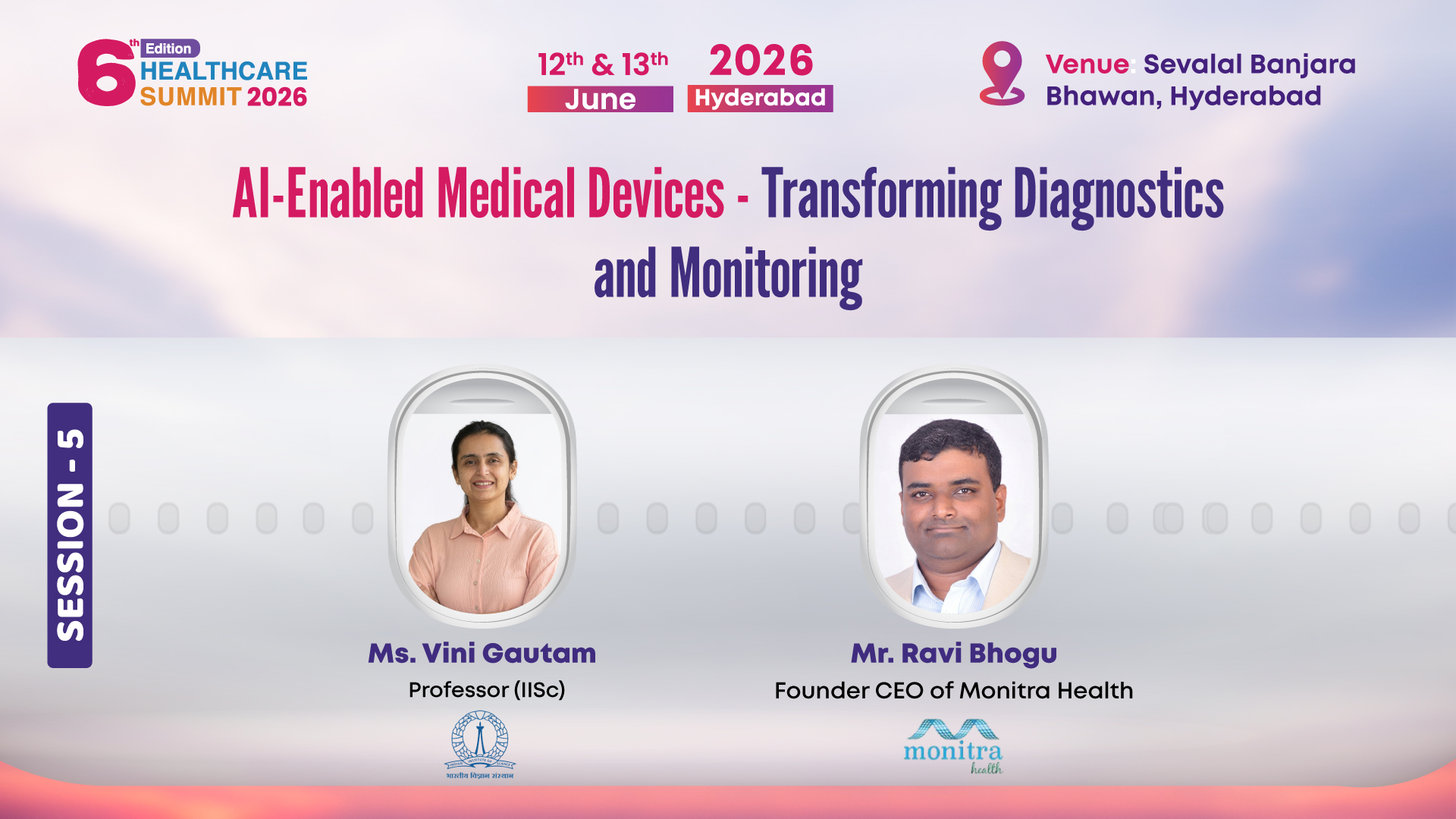
The session features Ms. Vini Gautam from the Indian Institute of Science, one of India’s most respected institutions for scientific research and technological innovation. Her work reflects the growing intersection of advanced engineering, computational science, and healthcare technologies.
Joining her is Mr. Ravi Bhogu, Founder and CEO of Monitra Health, a company recognized for developing innovative remote cardiac monitoring technologies. Monitra Health has contributed to advancing wearable and connected healthcare solutions that enable continuous monitoring and early intervention for cardiovascular conditions.
The discussion will examine how AI-powered devices are enhancing diagnostics across multiple specialties including cardiology, radiology, critical care, chronic disease management, and preventive healthcare. Speakers will explore how real-time data collection, predictive analytics, machine learning algorithms, and remote monitoring systems are enabling earlier detection of health risks and more personalized care pathways.
A major focus of the session will be accessibility and scalability. Intelligent devices have the potential to bridge healthcare gaps by extending diagnostic capabilities beyond hospitals and into homes, rural settings, and underserved communities. This is particularly significant for countries like India, where healthcare access remains uneven across regions.
The speakers will also address important challenges surrounding regulation, clinical validation, data privacy, interoperability, and physician adoption. As AI becomes increasingly embedded within medical technologies, ensuring safety, trust, and clinical effectiveness remains essential.
For clinicians, healthcare innovators, medical device companies, investors, researchers, and policymakers, this session provides valuable insights into one of the fastest-growing sectors within healthcare technology.
As medicine becomes increasingly data-driven, AI-enabled medical devices are expected to play a defining role in creating smarter, more proactive, and patient-centered healthcare ecosystems. This discussion offers a glimpse into how intelligent technologies are moving from innovation labs into everyday clinical practice.