
Indian Healthcare – Delivery Problem or Design Failure? Rethinking Systems, Not Just Solutions
India’s healthcare sector has made remarkable advances in medical expertise, pharmaceutical manufacturing, digital health innovation, and healthcare infrastructure. Yet millions continue to face challenges related to accessibility, affordability, continuity of care, health literacy, and healthcare outcomes.
This raises an important question: Are healthcare challenges primarily problems of delivery, or do they stem from deeper issues in system design?
This thought-provoking session challenges conventional approaches to healthcare reform and encourages participants to examine healthcare through the lens of systems thinking, human-centered design, policy innovation, and organizational transformation.
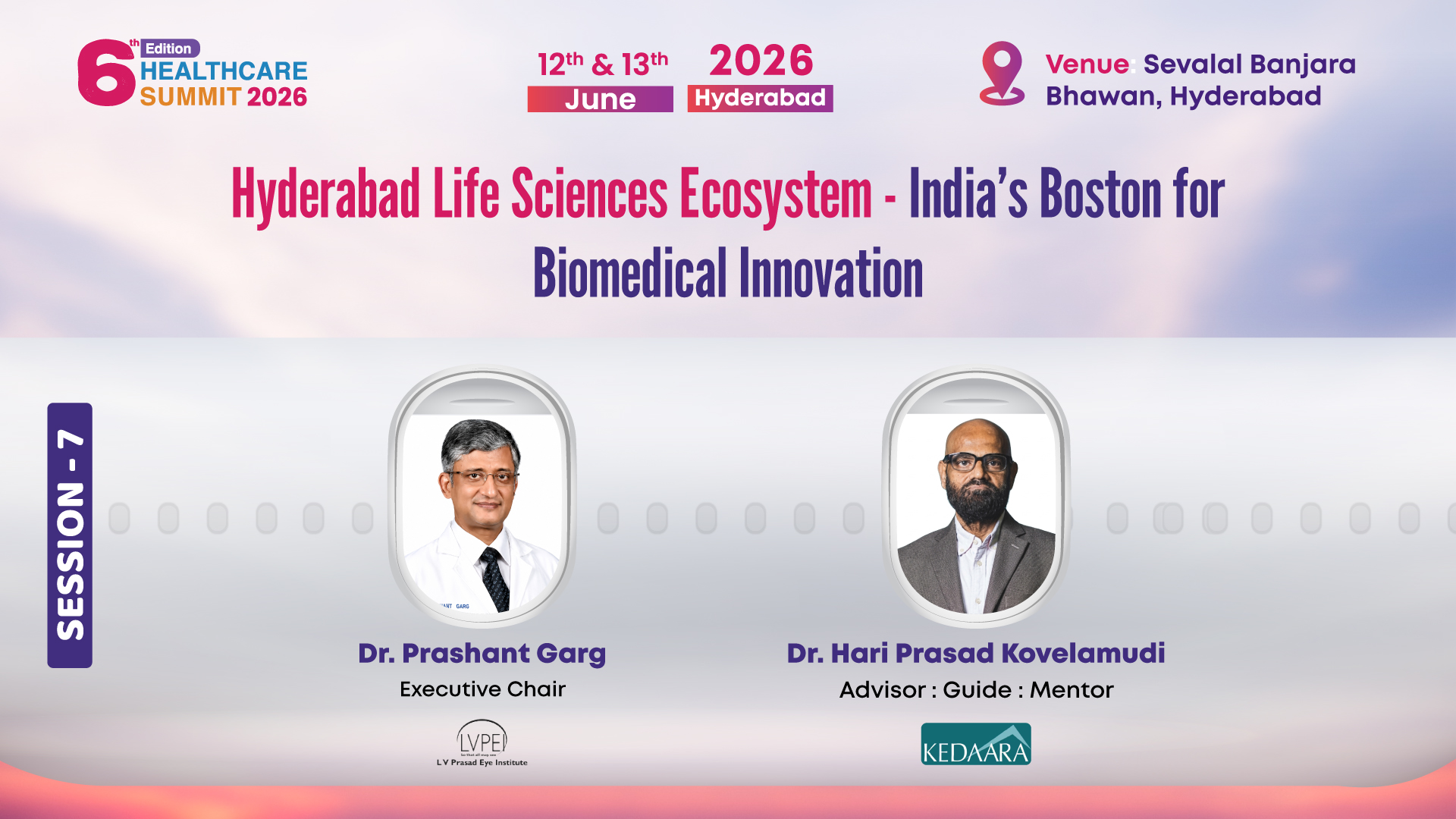
The discussion features two highly respected healthcare leaders who have spent decades shaping healthcare delivery models and institutional innovation.
Dr. Prashant Garg, Executive Chair of the LV Prasad Eye Institute (LVPEI), represents one of the most successful examples of scalable, equitable healthcare delivery in India. LVPEI’s globally recognized pyramidal model of eye care has demonstrated how excellence, accessibility, sustainability, and community impact can coexist within a single healthcare ecosystem. His experience provides valuable lessons for healthcare systems seeking to expand access without compromising quality.
Joining him is Dr. Hari Prasad Kovelamudi, a widely respected healthcare leader, advisor, mentor, and healthcare transformation expert. Having played leadership roles in some of India’s most influential healthcare organizations, Dr. Hari Prasad brings extensive experience in healthcare strategy, digital transformation, healthcare operations, innovation, and policy engagement.
The session will examine whether many healthcare challenges arise because systems are designed around institutions rather than patients. Topics include fragmented care pathways, provider incentives, digital integration gaps, workforce design, preventive care adoption, population health management, and healthcare accessibility.
A key discussion point will be how healthcare systems can move beyond isolated technological solutions and focus on redesigning entire care journeys. Speakers will explore how design thinking, behavioral science, technology integration, and ecosystem partnerships can create more effective and equitable healthcare models.
Attendees will gain insights into successful examples of healthcare redesign from India and around the world. The session aims to inspire healthcare leaders to think beyond incremental improvements and consider systemic transformation.
For policymakers, hospital leaders, clinicians, entrepreneurs, researchers, and healthcare innovators, this conversation offers a powerful framework for understanding how healthcare systems can be reimagined to better serve patients, communities, and society.
The future of healthcare may depend not only on better solutions, but on fundamentally better system design.